Fixed Price vs Quote-Based Web Design in the UK: Which One Is Right for Your Business?
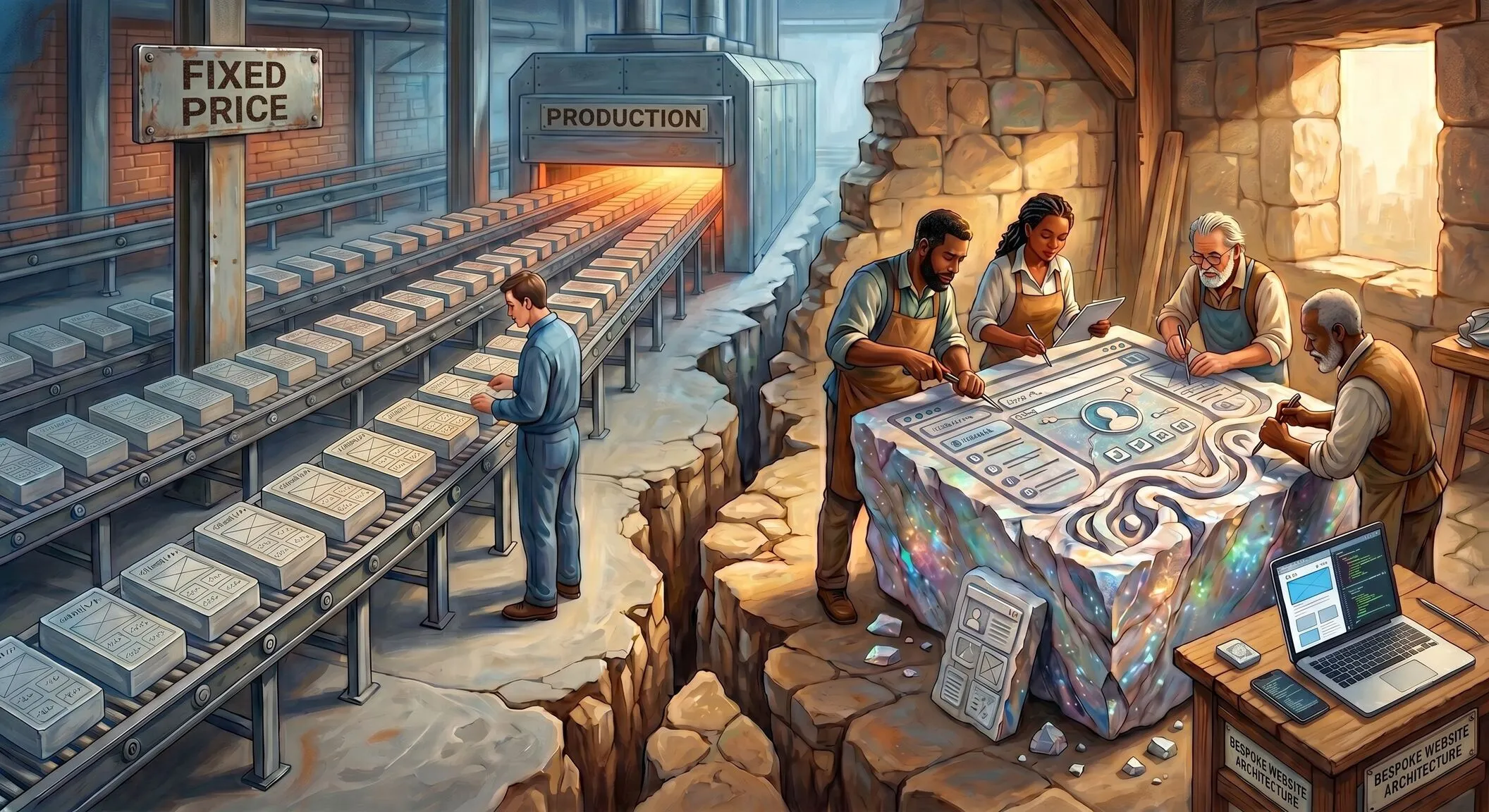
You've decided your small business needs a proper website, that's great news! The next question usually shows up within about 30 seconds of looking at web designers: why does one person show you a clear £399 package on their pricing page, while the next 3 ask you to "book a call" before they'll even mention a number?
That's the fixed price vs quote-based web design UK debate in a nutshell. It's a more important choice than most people realise - because the pricing model you pick shapes the scope, the timeline, the stress level & whether you end up with a website you actually use.
I've been building websites for UK small businesses for 12 years now & I've worked both sides. I've quoted for agencies where every line item was negotiated & I've built fixed-price packages where you know exactly what you're paying before we even start. This post is the honest comparison I wish more web designers would write. No trashing of the alternative, just a clear look at what each approach actually costs, what you get & when each one is the right call.
TL;DR
Fixed price web design is best when you know what you want, you need cost certainty, and the project fits a well-understood scope (most small business sites do). Quote-based pricing makes sense when the project is genuinely custom, large, or needs to grow over time. Working on projects with hourly rates are rarely the right choice for small businesses - it transfers all the risk to you.
If you're a tradesperson, local service business, consultant, or early-stage startup, a transparent fixed-price package will almost always give you a better outcome for less money.
Fixed price web design in the UK: what you're actually buying
Fixed price (sometimes called "productised" or "packaged") web design means the designer has taken the most common type of small business website, built a repeatable process around it & can quote you a firm number before you commit to anything. This is the model I'm currently working with for most websites, and it works well - for enterprise level/custom websites then these will always require a quote-based pricing anyway. But for those businesses who need something simple, then fixed-pricing is a great options for them to avoid incurring ghastly monthly fees like some other major platforms that lock you in.
For fixed pricing, you will usually see tiers, a starter, a standard, and a premium — with each tier listing exactly which pages, features and integrations are included. My own pricing page is set up this way. No mystery, no haggling, no "I'll send across a proposal".
What fixed price typically gets right:
- Cost certainty: You know the number. Your accountant knows the number. It doesn't change because a Zoom call ran too long.
- Faster timelines: Because the process is tight, fixed-price projects usually ship in 1-4 weeks rather than typical 2-4 months most agencies will have you endure.
- Fewer surprise emails: The scope is written down before anyone starts. There's nothing to argue about later.
- Better for comparison shopping: You can look at 3 web developers in an evening & actually compare their pricing in a predictable way.
Where fixed price has limits:
- If your needs sit outside the package, you're paying for an add-on or upgrade tier (which, to be fair, is normally still cheaper & clearer than a custom quote).
- Very bespoke features - a booking system custom-built for a niche trade, a complex membership area, deep CRM integration — don't always fit a package.
- You need to actually read what's included. A £399 package with no revisions isn't the same as a £399 package with two.
Typical UK fixed-price ranges, based on what I see across the market in 2026:
- Starter sites (one-page / small brochure): £399 – £900
- Standard small business site (4-8 pages): £900 – £2,200
- Premium packages (more pages, booking, blog, integrations): £2,200 – £3,500
These are realistic figures for a freelance designer working with UK small businesses. If you want to see what actually sits inside each tier at those prices, here's my current pricing breakdown.
Quote-based web design: when the number only exists after a conversation
A quote-based approach means the designer (or agency) will talk to you about your project first, then come back with a custom proposal. This is the default model for most traditional web design agencies.
Where quote-based really earns its keep:
- Genuinely complex projects. If you're integrating a bespoke stock system, building a members' area with tiered access, or connecting to three different APIs, no package will cover it cleanly.
- Larger teams with multiple stakeholders. When legal, brand, marketing, and ops all need input, the discovery work genuinely matters.
- Ongoing relationships. If you want a partner who'll redesign, maintain, and evolve the site over years, a custom quote reflects the real commitment.
Where quote-based tends to bite small businesses:
- The price can swing enormously. A quote for "a small business website" from a UK agency could come back at £2,500 or £18,000 depending on who you ask, with very little to help you tell which is fair.
- Scope creep is baked in. Whatever you didn't mention in the initial call becomes a "change request" later — and change requests are rarely cheap.
- The cost of comparing is high. To get three comparable quotes, you're committing to three discovery calls, three proposals, and a fortnight of your own time.
- Simple needs get over-engineered. Agencies have agency overheads, and those overheads get built into the quote even if you didn't need an agency-sized solution.
Typical UK quote-based ranges:
- Freelancer, quote-based: £1,500 – £8,000 for a small business site
- Boutique agency: £5,000 – £15,000
- Mid-size agency: £10,000 – £40,000+
The same brief — a tradesperson needing a seven-page site with a contact form and gallery — can land anywhere in that range. That's not a criticism of quote-based pricing, it's just the nature of it.
Hourly / time and materials: almost never right for a whole site
Hourly sits between the other two and is the riskiest for a small business buying a complete website. You're told a rate, maybe an estimate, and you pay for actual time spent.
UK hourly rates roughly shake out as: freelancers £35 - £100/hour, specialist developers £80 - £150/hour, agencies £100 - £200/hour+.
The problem isn't the rate. It's that a "small business website" can take anywhere from 30 to 150 hours depending on how the project runs. That's an £1,800 difference at the low end and an £18,000 difference at agency rates & you don't find out which one you got until the invoices have already arrived.
Hourly does make sense for ongoing work after a site is live. It doesn't make sense for "please build me a website".
When fixed price web design is the right call
A fixed-price package is almost certainly the better choice if any of these sound like you:
- You run a local service business — plumber, electrician, carpenter, cleaner, personal trainer, mobile mechanic, therapist. The site you need is a well-solved problem, and there's no reason to pay for bespoke discovery.
- You're a sole trader or small startup with a budget you can actually name. Cost certainty matters more to you than theoretical custom features you won't use.
- You want to be live in weeks, not months. Packaged processes ship faster because the designer has built the same structure many times.
- You can describe your site in one or two sentences without needing a spreadsheet.
- You're replacing a tired site that hasn't been doing its job. Most small business redesigns fit a standard shape — they just need to be done properly.
If you're not sure which package fits, my free website audit will tell you what your current site is and isn't doing, and what kind of rebuild would actually move the needle.
When quote-based makes more sense (being fair)
I'd steer you toward a traditional quote-based approach if:
- Your project needs deep custom functionality — custom bookings, complex e-commerce with unusual rules, learning management, a members' area with tiered content.
- You're integrating with legacy systems, industry-specific software, or bespoke back-office tools.
- You have a team of stakeholders and genuine discovery is needed before anyone can sensibly design anything.
- You're planning for multi-year growth and want a design partner rather than a package.
- Your budget is comfortably five figures and you want to spend it well.
None of those apply to most UK small businesses. But when they do, a good quote-based designer or agency will give you far better value than trying to wedge a complex project into a fixed-price box.
Red flags to watch out for (either model)
Both approaches can be done well, and both can be done badly. A few things to look for before you hand anyone a deposit:
- "From £X" with nothing showing what "from" actually includes. Transparent pricing tells you what's at the lower end and the upper end.
- Quotes that arrive as PDFs with no line items. If you can't see what each pound is buying, neither can they.
- Designers who won't tell you their hosting, domain, or ongoing costs. These should always be stated up front.
- No mention of revisions, support, or what happens if something breaks after launch.
- Prices that feel too cheap to be real. A £79 "small business website" is almost always a template with your logo pasted on, set up in a way you can't maintain.
So, which should you pick?
If you're a UK small business owner, tradesperson, or early-stage startup looking for a site that does its job, a transparent fixed-price package will almost always give you a better outcome, faster, with less stress — and the price on the tin is the price you pay.
If your project is genuinely complex, large, or custom, a quote-based approach from the right designer or agency will serve you much better than trying to squeeze it into a box.
If you're not sure which camp you fall into, I'd rather talk you out of hiring me than sell you the wrong thing. Have a look at my fixed-price packages to see whether your project fits, or if you already have a site you're not sure about, book a free website audit and I'll tell you what's actually worth doing next.